
The GSAT-31 is a 'high power' communication satellite going to serve and replace some of the satellites that are going to expire soon.

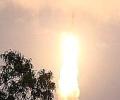
K Radhakrishnan, chairman of the Indian Space Research Organisation, has said that India is preparing to launch its second moon mission Chandrayaan-II by 2013. "The Chandrayaan-II we are planning to have in the year 2013. By that time, we should have our GSLV (Geosynchronous Satellite Launch Vehicle) flying with the Indigenous Cryogenic Engine Stage. That is the target with which we are working," said Radhakrishnan.

In terms of success rate, the PSLV rocket has an enviable record of 57 successful missions out of 58 commercial ones.
The launch is slated for 1658 IST from the space port at Sriharikota in Andhra Pradesh.
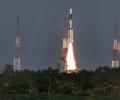
The satellite will enable a full range of services to neighbours including the areas of telecommunication, television, direct-to-home, VSATs, tele-education and tele-medicine.

Twice every 12 days, the NISAR satellite will scan nearly all of earth's land and ice surfaces to measure changes in the planet's ecosystems, growth and retreat of its land and sea ice, and deformation of its crust.
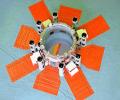
The Indian Space Research Organisation will open 2025 scoring a century orbiting the country's navigation satellite 2,250 kg NVS-02 with its rocket Geosynchronous Satellite Launch Vehicle (GSLV)-F15.

A high power satellite, GSAT-15 is being inducted into the INSAT/GSAT system. GSAT-15 carries a total of 24 communication transponders in Ku-band as well as a GPS-Aided GEO Augmented Navigation (GAGAN) payload operating in L1 and L5 bands.
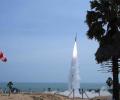
The fuel cost will come down if rockets are launched from Kulasekarapattinam as they will have a straight trajectory and need not have to avoid Sri Lanka, which is being done by rockets flown from Sriharikota.

The 3,423 kg GSAT-29 carries Ka and Ku band high throughput transponders intended to meet the communication requirements of users, including in the North East and in Jammu and Kashmir.

The move follows a quiet visit by National Security Advisor Ajit Kumar Doval to the Vikram Sarabhai Space Centre in Thiruvananthapuram.
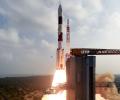
The Indian Space Research Organisation (ISRO) is all set to make its maiden commercial launch of 36 broadband communication satellites on board the space agency's heaviest rocket LVM3-M2, the countdown for which began early on Saturday at Sriharikota spaceport in Andhra Pradesh.
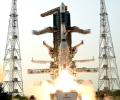
Over 32 missions -- satellites and rockets -- have been planned for the year.
The flight took off from Sriharikota in the Bay of Bengal on schedule.

India's heaviest rocket ever is expected to take to the sky next January on an experimental flight whose later versions could be used to send humans on space missions.
The satellite was placed at 4.18 pm, a little over 17 minutes after the Geosynchronous Satellite Launch Vehicle (GSLV-F-01) carrying it was launched from the Satish Dhawan Space Centre in Sriharikota.
The apogee [farthest point] is 36,000km and the inclination of the orbit with respect to the equatorial plane has been reduced from 7.37 degrees to the present 0.32 degrees,
K Narayana, former director of SDSC-SHAR and currently senior advisor to the Centre, will chair the 15-member panel

PSLV C-29 blasted off from the Satish Dhawan Space Centre, about 110 km from Chennai, at 6 pm and released the six satellites one by one into a 550 km circular orbit.
The Indian government must support ISRO so that it is able to achieve its goal of becoming self-sufficient in all segments of the space business. The highly successful PSLV programme is a testimony to its capabilities. Now it needs to demonstrate the same with GSLV. Nothing should waver it from this goal. Not even competition with China, says Dinesh C Sharma

The Department of Space (DoS) plans to realise entirely-built rockets -- GSLV-Mk III and SSLV -- from Indian industry partners, in addition to PSLV, according to a top official of its commercial arm NSIL.

On Sunday morning, in its mission to place an earth observation satellite and students satellite into the low earth orbit, the SSLV-D1/EOS-02 blasted off precisely at 9.18 am amid cloudy skies from the first launch pad at Satish Dhawan Space Centre in this spaceport.
The Mars mission should not have been a priority at this stage for India which, instead, ought to have devoted time and energy on getting its rocket operational again and give momentum to the human space flight programme, former ISRO chief G Madhavan Nair said.

The satellite would provide a thrust to mobile communication through multi-beam coverage facility, the ISRO said.

ISRO launched 12 Indian, 22 foreign satellites and successfully flight-tested India's first winged-body aerospace vehicle.
The Indian Space Research Organisation on Thursday achieved a significant milestone in Mahendragiri, Tamil Nadu, when it successfully tested the indigenously developed Cryogenic Stage, to be employed as the upper stage of India's Geosynchronous Satellite Launch Vehicle.
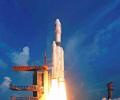
The rocket can put satellites weighing upto four tonnes in space, double the weight that the current GSLV-Mark-II can lift.
India's top space scientists are analysing data to find out what caused the failure of Geosynchronous Satellite Launch Vehicle mission and an expert committee is likely to be formed soon to give a report on it.
It's time that we, as a nation, stopped fearing failure and waiting for instant success in our space ventures. Let us instead applaud the journey, even if it comes at a certain cost to the taxpayer.

And the first Indian to go into space from 'Indian soil' could well be a woman.
'The solution is to replace, clean up, retest and proceed.' 'There is nothing to worry about if corrected.'

The Indian Space Research Organisation successfully put India's heavy rocket Geosynchronous Satellite Launch Vehicle-Development 5 (GSLV-D5) into orbit from the spaceport at Sriharikota, Andhra Pradesh at 4.18 pm on Sunday.

'Today, when we talk of success of PSLV and GSLV Mk III, we owe it to important inputs that the Prof. Narasimha committee gave'

The ISRO on Sunday scripted yet another history after its LVM3 rocket successfully placed 36 satellites of United Kingdom-based OneWeb group company into intended orbits.
The placing of four satellites into orbit on October 12, 2011 is yet another milestone in the glorious career of Indian Space Research Organisation's trusted Polar Satellite Launch Vehicle.

ISRO Chairman K Sivan described the GSAT-11 as the "richest space asset" for India.
The placing of four satellites into orbit on October 12, 2011 is yet another milestone in the glorious career of Indian Space Research Organisation's trusted Polar Satellite Launch Vehicle.
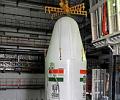
The launch of a Geosynchronous Satellite Launch Vehicle was called off by the Indian Space Reasearch Organisation at the eleventh hour on Monday due to a fuel leak in its second stage -- in a setback to the mission to test its homegrown cryogenic engine -- after its failure three years ago.
